Hello folks, been some time since a posting, can only blame it on the usual: working outside, laziness, and doing other things than being on a computer. One new hobby of mine is art, art in the plastic sense, not in tending fruit. Yes, I've been dipping into my long unused creative well and trying all kinds of things with watercolors, acrylics, and my favorite, oil pastels. I've been particularly inspired by Odilion Redon, Schwitters, Klee, and Lee Krasner. More of the expressionist, abstracty kind of vibe.
Now to the matter at hand. Codling moth in apples and pears is a major pest problem that you are guaranteed to have. Check out this Wikipedia site http://en.wikipedia.org/wiki/Codling_moth for more great details. Codling moth is the worm at the center of the apple, which is the larva that has burrowed into the apple after being laid as an egg on the surface of the apple. In large orchards (1+ acres) the use of pheromone lures is rapidly advancing. The Pheromone lures essentially make it really hard for the moths to mate, therefore no eggs can be laid on apples which will burrow into the center. This use of pheromone lures is called mating disruption. For us small time back yard orchardists, the only guaranteed method of protection is a physical barrier, either sprayed on as in the use of kaolin clay (brand name Surround), or by use of nylon baggies that cover the apple and create a protective barrier. The baggies are fairly easy to use, won't interfere with the ripening of the apple (it will actually prevent sunburn on the fruit), and can be reused unlike paper bags. The best time to use the baggies is after thinning your apples (when the fruit is the size of a grape). There are lots of YouTube videos that will show this. I am having technical difficulties uploading my pictures to this blog, so you will have to venture out on your own..... sorry!
All the best in the spring.
Thursday, April 2, 2015

Oregeon Spring Weather
Okay, two years since my last posting... no excuses, I've been playing outside too much. Oregon spring 2015 is here and it is cool and wet. After record breaking temps in March, April is starting off where we left off in February. Alas, most of my trees have bloomed but the Hudson's Golden Gem and Cox's Orange Pippin are in or starting to flower. It will be a tough year for them I believe.
I am planning on posting some coddling moth management pictures next, just figuring out some technical issues with BlogSpot. Stay tuned.
I am planning on posting some coddling moth management pictures next, just figuring out some technical issues with BlogSpot. Stay tuned.
Tuesday, March 5, 2013
Tending Fruit: An Urban Fruit Tree Growing Guide Now Available!!
Hello Folks, I am excited to finally offer after a year in the making, Tending Fruit: An Urban Fruit Tree Growing Guide written by yours truly.
Tending Fruit
An Urban Fruit Tree Growing Guide

(Sample of Cover Page)
Tending Fruit is geared towards those new to fruit tree growing and live in the Pacific Northwest, but it has basic principles that apply to fruit tree management in any area as well as offering a few surprises! Now you can have your own copy in two easy ways: 1. An online version or 2. Hard copy. I know books are slowly going out of fashion, so I can offer to send you a copy via email. Here's how it will work:
Simply select the form of Tending Fruit you would like to buy above the 'Buy Now' button at right and follow the prompts to pay, Make sure to include your email address if you are getting a PDF version and your home address if getting a hard copy! Please allow 1-3 business days for delivery of PDF copies and 7 business days for hard copies.
The book has plenty of pictures, lots of line drawings of tree forms, and covers everything from tree selection to fruit thinning to pest and disease management. I am excited to offer this work and to hear comments and feedback. After all, fruit tree growing is a learning process.
Tending Fruit
An Urban Fruit Tree Growing Guide

(Sample of Cover Page)
Tending Fruit is geared towards those new to fruit tree growing and live in the Pacific Northwest, but it has basic principles that apply to fruit tree management in any area as well as offering a few surprises! Now you can have your own copy in two easy ways: 1. An online version or 2. Hard copy. I know books are slowly going out of fashion, so I can offer to send you a copy via email. Here's how it will work:
Simply select the form of Tending Fruit you would like to buy above the 'Buy Now' button at right and follow the prompts to pay, Make sure to include your email address if you are getting a PDF version and your home address if getting a hard copy! Please allow 1-3 business days for delivery of PDF copies and 7 business days for hard copies.
The book has plenty of pictures, lots of line drawings of tree forms, and covers everything from tree selection to fruit thinning to pest and disease management. I am excited to offer this work and to hear comments and feedback. After all, fruit tree growing is a learning process.
Wednesday, February 13, 2013
It has been some time since my last blog.... no real excuses except time just keeps moving on. Now is the time of year (Jan.-March in Portland) to plant your new tree! I prefer buying bear root trees from the nursery as they tend to be more vigorous after planting. Below is a step by step pictorial guide to planting your bear root tree. Happy February.


With
the fruit tree centered in the area of planting, measure the size of the
planting hole, generally 2x as wide as the area of the roots


Perform
the Initial Pruning Cut of the tree to about 2-2.5’ above the ground


Tree
Planting Guide

Bare root Tree from Nursery – Buy your tree
or have it shipped to you in the winter


Using
a digging fork, excavate the area for the tree hole putting the dirt removed to
the sides of the hole

Place
the tree in the excavated hole so that the roots spread out naturally to all
sides and the graft union is 2-3” above the soil line

Refill
the hole with the soil removed, tamping it lightly as you go and keeping the
tree as vertical and straight as possible. Fertilize the planted tree with about a cup of pelleted
fertilizer spread evenly around the planting area

Mulch
the entire 12’-12’ grass free area about 6-8” deep

Water
the tree lightly over the entire planting area until there is standing water

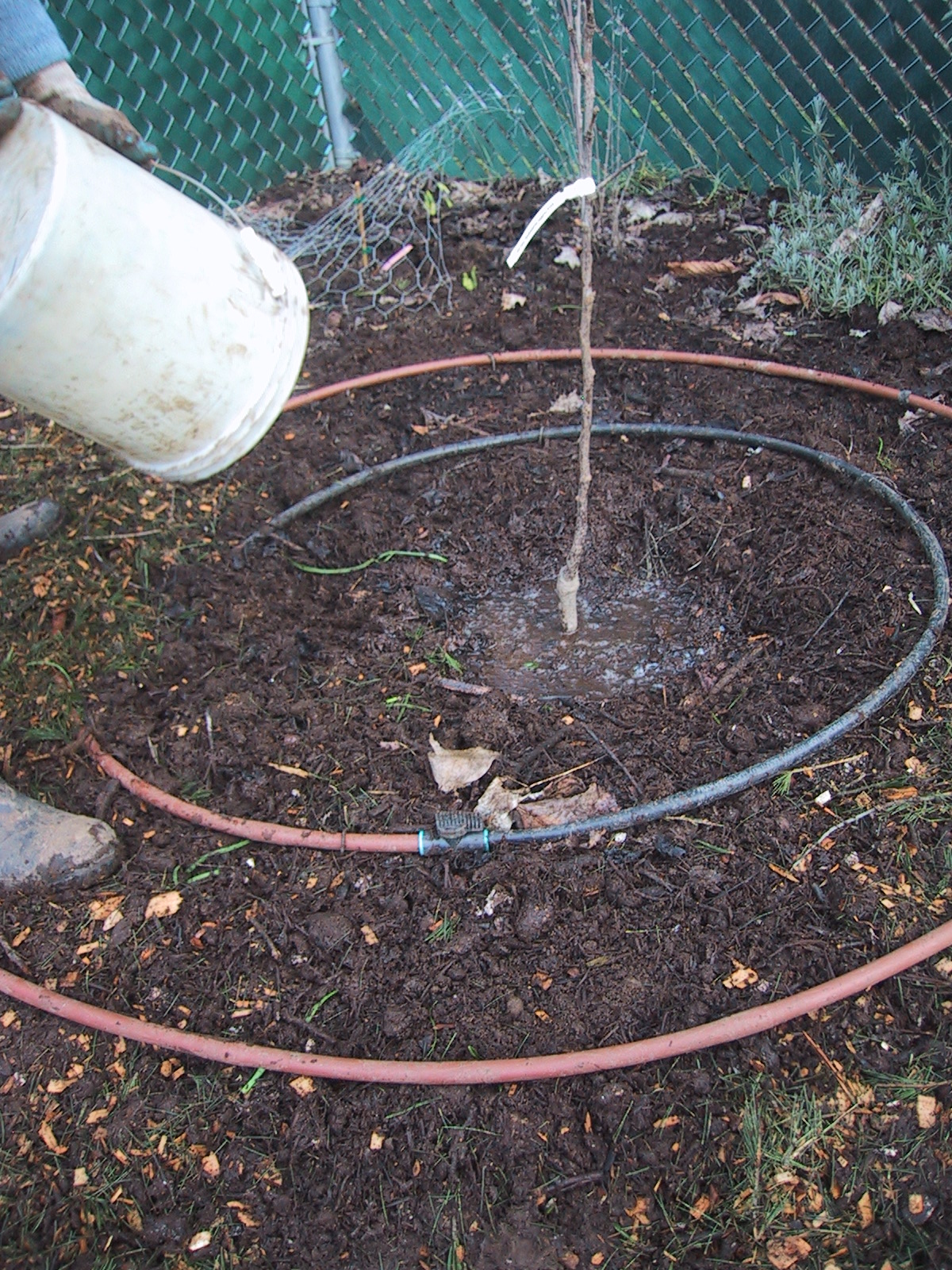


Exceptions to the Rule #1 and #2:
1.
Do not perform initial pruning cut to stone fruits as
they are very susceptible to bacterial canker in the winter in the Pacific North West. Stone fruits are generally precocious and
should grow well without the initial pruning.
2.
Do not perform initial pruning cut to a tree grafted
with multiple varieties as you could most likely prune out all your grafts!!
Sunday, December 11, 2011
Fruit Badger Youngling Sited

Our first siting of a youngling fruit badger! Ahhh such a cutey learning the ways of fruit! Thanks for your picture Cheryl and Lenny.
Thursday, October 20, 2011
Now Taking Your Pictures of Fruit Badger Sitings!
Send in your photos of sitings of the elusive fruit badger! Add to the much needed knowledge of this secretive animal! Send them to j_iott@hotmail.com. Thanks!
Sunday, September 11, 2011
Late Summer Update
Well how the heck did it get to be September already? Again this summer in Portland, we had a cool wet early summer, with rain and cool temps (nights in the low 50's) up until July, and even July was mild. Only now in the beginnings of September, are we having 'warmer than average' temps with highs in the 90's. Ah, can't really win with Climate Change, but I guess be satisfied with what you get. We certainly are lucky to have plenty of water, unlike much of the rest of the country.
So, below are the latest and greatest of our now two year old baby orchard. Overall I am very happy with its progress, and have two trees which I call challenged, which required heading back again this winter, in order to achieve the first flush of growth that would give us our structural branches. One is our Akane, a relatively new variety that only produced a single, long water sprout last year. The other was our Klapp's Favorite Pear, which did the same thing, bearing only moderate, lop-sided new growth. I am happy to report that both are doing fine and have produced abundant new choices of growth after a second heading cut this winter past.
I was able to expand the diameter of the irrigation tubing around each of the trees by adding an additional 10' to each tree. The picture below gives an idea of what I am talking about.

As you can see, I have tried to get water to as much of the root zone as possible. This size ring with probably be good for the next 3-4 years, at which time I may add another 10-20 feet. These emitter tubing type irrigation lines have emitters spaced evenly within the tubing, so they don't clog or pop off, and are can be spaced 8", 10", 12", and 18" apart. The ones I use are 18" apart. At the moment, I am running sets of irrigation every two weeks for 5-6 hours. The emitters release 1 gallon per hour, so I am putting approximately 5-6 gallons of water per square foot every two weeks over an area of about 100 sq. ft. I have discovered a great website, http://weather.wsu.edu/, where I can track the daily evapotransperation rates for our area here in the Pacific Northwest. Using this information, I can calculate out how many gallons of water the trees need daily, which easily can be extrapolated out to a week.... but I digress. Robert Kourick has a great book all about garden irrigation, where he outlines how to do this math, and he does it well.
Below is a picture of our Hudson's Golden gem in its full glory. Note the almost 4' of extension growth this season! What a marvelous example of an open center tree form.
 Below is our Korean Giant Asian Pear which chose to take on a beautiful central leader form. I am quite happy with this tree, and have only had to do minimal training so far. Though it is already 9' tall after its second season! Yikes, good thing it is in the back of the garden!
 Finally here is an image of one of the trees that I headed back a second time this winter to inspire better initial growth. I believe it is our Klapp's Favorite, but as you can see, it is making a best second effort.
 The only sad news, that is both baffling to me and a bit frustrating is our Green Gage Plum. At this moment, it is near leafless, and has put on no new extension growth this season, despite a great showing in the spring. I believe it is Verticillium Wilt, but have not confirmed this, and a sample twig did not show the characteristic black streaking in the cambium/phloem layer. I am hoping with a bit of compost, and a more judicious spray program next season, it will fully recover.
The next goals for the orchard this fall, is to compost each tree, and re chip the entire area. That will see them through until the spring.
Until next time, whenever that is.
So, below are the latest and greatest of our now two year old baby orchard. Overall I am very happy with its progress, and have two trees which I call challenged, which required heading back again this winter, in order to achieve the first flush of growth that would give us our structural branches. One is our Akane, a relatively new variety that only produced a single, long water sprout last year. The other was our Klapp's Favorite Pear, which did the same thing, bearing only moderate, lop-sided new growth. I am happy to report that both are doing fine and have produced abundant new choices of growth after a second heading cut this winter past.
I was able to expand the diameter of the irrigation tubing around each of the trees by adding an additional 10' to each tree. The picture below gives an idea of what I am talking about.

As you can see, I have tried to get water to as much of the root zone as possible. This size ring with probably be good for the next 3-4 years, at which time I may add another 10-20 feet. These emitter tubing type irrigation lines have emitters spaced evenly within the tubing, so they don't clog or pop off, and are can be spaced 8", 10", 12", and 18" apart. The ones I use are 18" apart. At the moment, I am running sets of irrigation every two weeks for 5-6 hours. The emitters release 1 gallon per hour, so I am putting approximately 5-6 gallons of water per square foot every two weeks over an area of about 100 sq. ft. I have discovered a great website, http://weather.wsu.edu/, where I can track the daily evapotransperation rates for our area here in the Pacific Northwest. Using this information, I can calculate out how many gallons of water the trees need daily, which easily can be extrapolated out to a week.... but I digress. Robert Kourick has a great book all about garden irrigation, where he outlines how to do this math, and he does it well.
Below is a picture of our Hudson's Golden gem in its full glory. Note the almost 4' of extension growth this season! What a marvelous example of an open center tree form.
 Below is our Korean Giant Asian Pear which chose to take on a beautiful central leader form. I am quite happy with this tree, and have only had to do minimal training so far. Though it is already 9' tall after its second season! Yikes, good thing it is in the back of the garden!
 Finally here is an image of one of the trees that I headed back a second time this winter to inspire better initial growth. I believe it is our Klapp's Favorite, but as you can see, it is making a best second effort.
 The only sad news, that is both baffling to me and a bit frustrating is our Green Gage Plum. At this moment, it is near leafless, and has put on no new extension growth this season, despite a great showing in the spring. I believe it is Verticillium Wilt, but have not confirmed this, and a sample twig did not show the characteristic black streaking in the cambium/phloem layer. I am hoping with a bit of compost, and a more judicious spray program next season, it will fully recover.
The next goals for the orchard this fall, is to compost each tree, and re chip the entire area. That will see them through until the spring.
Until next time, whenever that is.
Subscribe to:
Posts (Atom)